

For Black women, being told that something is “normal” does not always mean it should be accepted.
A change in the skin, hair that is thinning around the edges or disappearing from the crown. Persistent pigmentation left behind by a spot that was there for days. These can be dismissed, misunderstood or treated as cosmetic concerns when, for many women, they are signs of something that deserves a closer look.
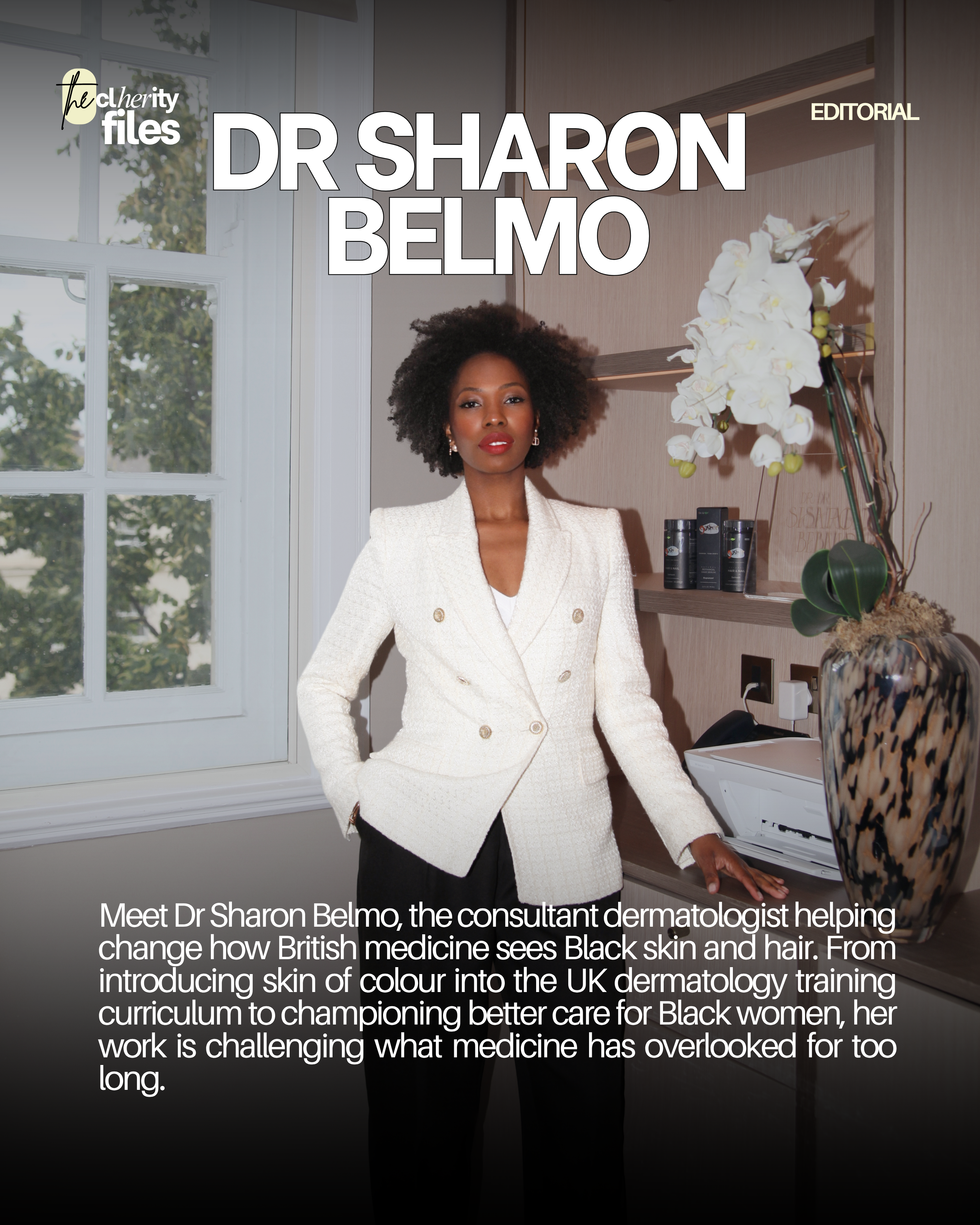
Dr Sharon Belmo has spent her career asking medicine to look more carefully.
A consultant dermatologist with specialist interests in skin of colour and hair loss, Dr Belmo has become a prominent voice in improving how darker skin and Afro textured hair are understood within dermatology. Her work has included bringing skin of colour into UK dermatology training and developing resources to address the lack of representation in medical education.
For Clherity Files, we spoke to Dr Belmo about what she sees in her clinic, why some of the most common advice given to Black women can miss the mark, and what happens when skin and hair symptoms intersect with hormonal and metabolic health.
Here, she talks to us about diagnosis, representation, hair loss, pigmentation, PMOS and the importance of knowing when not to simply accept what you have been told.
The most common skin concerns I see amongst women in my clinic are acne, different forms of hyperpigmentation and wishes for general skincare advice and routines.
I now predominantly treat hair loss and see a lot of women with traction alopecia, seborrhoeic dermatitis, female pattern hair loss, CCCA and other forms of scarring alopecias. It is not uncommon at all in my clinic to see a combination of different hair loss conditions in one patient, and many patients come to me with both skin and hair concerns.
In darker skin, inflammation, such as that caused by acne, a scratch, a burn, can stimulate our melanocytes, the cells that produce melanin (pigment). After the inflammation has settled, the pigment lingers leaving behind dark marks. This is called post-inflammatory hyperpigmentation.
You can have a spot that was present for a few days, but the pigmentation it leaves behind can remain for months, sometimes considerably longer. This is why treating the acne properly is so important. Every new inflammatory spot has the potential to create another mark.
An important thing to note about pigmentation is not to attack it too aggressively. I often see people using multiple acids, scrubs, bleaching products or strong retinoids because they want the marks gone quickly, but irritation can create more inflammation and therefore more pigmentation.
The most important aspect in treating PIH is addressing the cause. This can be done separately or in combination with treatments for pigmentation, but it must be done. If the cause is not addressed, the pigmentation will continue.
Excess facial hair, or hirsutism, can be particularly distressing because it is visible and can have a significant impact on confidence. It can be more visible in Black women due to the dark colour of the hair and may also be genetic in some cases.
It can be associated with hormonal conditions such as PMOS, but not every woman with unwanted facial hair has a hormonal disorder. I always look at the wider picture, when the hair started, how quickly it is changing, menstrual history, family history and any other symptoms, to help establish the cause.
In terms of treatment, we can use a combination of approaches. However, in most cases, Laser hair removal tends to work best. In darker skin it is particularly important that the correct laser and settings are used. I generally favour long pulsed Nd:YAG laser for deeper skin tones because it has a better safety profile when used appropriately.
Hormonal treatment may also be appropriate for some women, depending on the underlying cause.
It is important to note that hair removal in darker skin needs to be approached differently. The aim isn't simply to remove the hair, it's to do so without causing burns, pigmentation or scarring.
One of the conditions I see particularly frequently in Black women is central centrifugal cicatricial alopecia, or CCCA, which is a form of scarring hair loss that typically begins around the crown and can gradually spread.
I also see traction alopecia, particularly around the hairline, as well as female pattern hair loss and other inflammatory scalp conditions.
One of the biggest misconceptions is that all hair loss is caused by hair styling and can be treated with products such as oils.
Another misconception is that if something is marketed as "natural", it must be safe or effective. People can spend years using oils, supplements and home remedies while an inflammatory or scarring form of hair loss continues underneath leading to permanent hair loss.
Acanthosis nigricans usually appears as darker, thicker or velvety skin, most commonly around the neck, underarms, groin or sometimes other skin folds.
It's important because it can sometimes be a sign of insulin resistance / diabetes, although there are other causes as well. In someone who develops such changes, particularly if there are other risk factors for conditions like diabetes, I would recommend discussing it with a healthcare professional.
Dermatology has historically been taught predominantly using images of lighter skin, and that creates a problem because many conditions don't look the same across different skin tones.
For example, inflammation can be much less obviously red in darker skin. Instead, you may see subtle changes in brown, grey or violaceous tones, or changes in texture. If clinicians aren't trained to recognise those differences, diagnoses can be delayed.
And this isn't simply about having more photographs in a textbook. We need systematic representation throughout medical education, in lectures, textbooks, examinations, clinical teaching and postgraduate training.
I introduced dermatology for skin of colour into the UK dermatology training programme in 2021, meaning now all dermatology trainees have a formal requirement to have some experience in skin of colour. What I would like to see next is more emphasis on understanding skin of colour as part of mainstream dermatology, rather than treating it as a separate or optional topic. Ultimately, better education means better recognition, earlier diagnosis and better treatment for patients.
Probably the biggest mistake is changing too many things at once. People often come to me using five, six or even ten different products because they have been trying to solve the problem themselves. That can make it incredibly difficult to work out what is helping, what is irritating the skin and what may be making things worse.
And importantly, don't be embarrassed about anything, particularly hair loss. These are medical concerns that as a dermatologist, I see every day and delaying being seen and treated can result in irreversible hair loss.
I think the most important thing is to understand that the skin and hair can reflect what is happening hormonally, but they can also be treated in their own right.
If you have PMOS, for example, you don't have to simply accept acne, unwanted facial hair or hair thinning as something you must live with.
At the same time, treating the skin doesn't necessarily mean the underlying hormonal issue has been addressed. A multidisciplinary approach is generally required with a GP, endocrinologist, gynaecologist and dermatologist often all having a role to play.
Don't normalise something that is bothering you just because you've been told it's normal for Black women.
If something is changing, persisting or affecting your confidence, get the right diagnosis rather than endlessly trying products.
Don’t be afraid to advocate for yourself. If you feel that your skin or hair hasn't been properly understood, it's okay to challenge this and/or seek another opinion.
What Dr Belmo asks of women is not perfection, and it is not endless research into their own bodies but attention. To notice what is changing, to question what does not feel right and to seek care that understands the skin and hair in front of it.
For Black women, being properly seen should not be an exception to good healthcare. It should be part of it.
You don't have to figure it out alone
Join the Clherity community — a private space for women navigating PCOS together.
Join the waitlist →