
Polycystic Ovary Syndrome has long been framed in the narrowest of terms. For many women, the public conversation around PCOS begins and ends with irregular periods, fertility concerns, acne, or excess hair growth.
But this limited narrative fails to capture the far more complex biological, psychological, and neurological realities that millions of women navigate every single day.
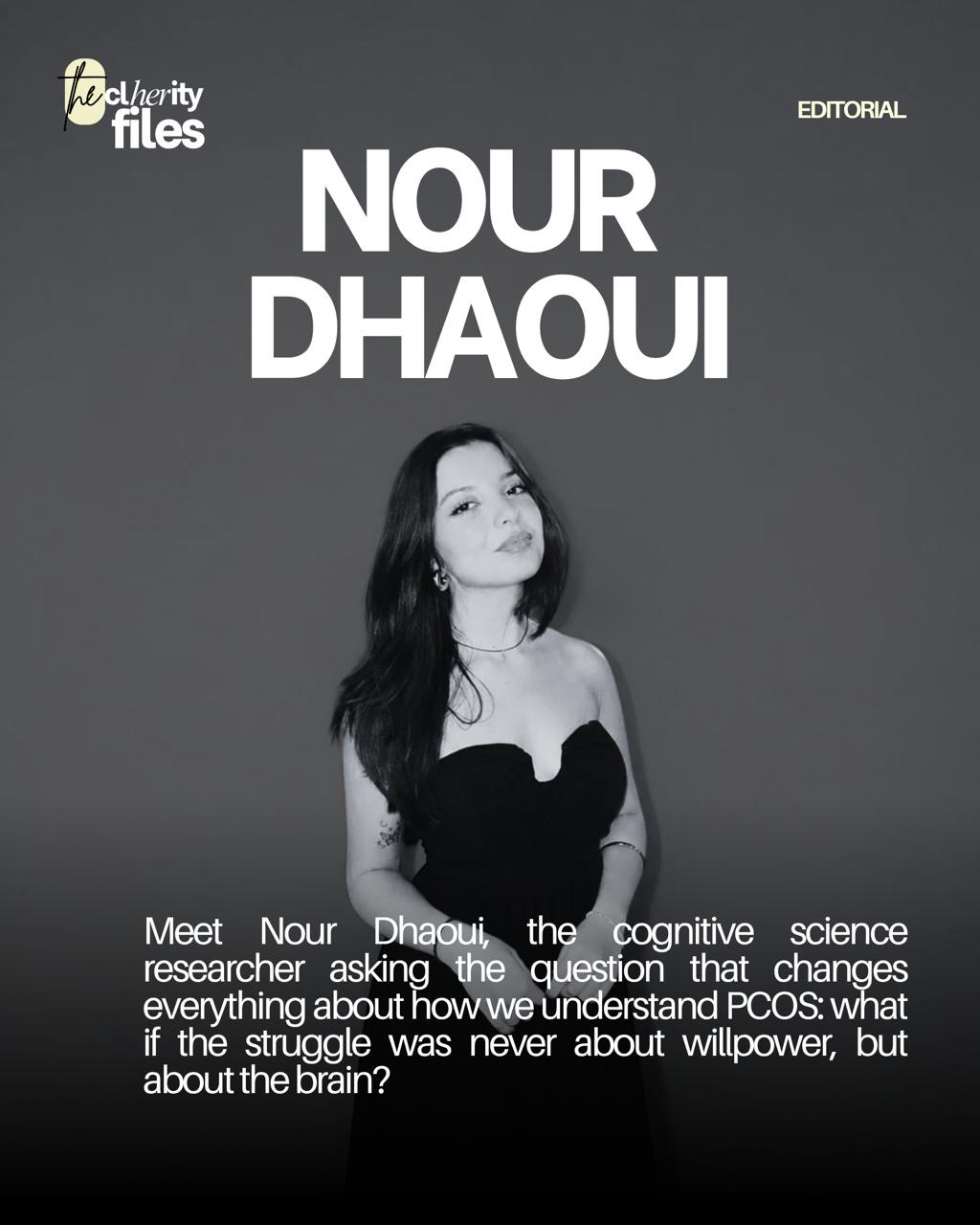
Nour Dhaoui is part of a new generation of cognitive science thinkers challenging that incomplete understanding. Currently studying cognitive science at Université Lumière Lyon 2, her recent research into the neurobiological relationship between PCOS and eating disorders offers a perspective that is both important and profoundly overlooked: for many women, PCOS may not simply disrupt reproductive hormones, but also directly affect the brain systems governing hunger, reward, stress, and emotional regulation. Her work reframes PCOS not as a condition of willpower or lifestyle failure, but as a deeply complex syndrome that can shape how women experience food, body image, cognition, and mental wellbeing.
In this conversation, Nour unpacks why PCOS deserves to be understood far beyond its reproductive symptoms, and why more integrated, psychologically informed care is long overdue.
It started as an assignment on neuroendocrinology and eating disorders. But it quickly became personal. I had always heard about polycystic ovary syndrome described in the most reductive terms: a condition that makes you hairier, gives you acne, messes with your cycle. It seemed like a condition that was consistently overlooked and labelled as purely hormonal, as if we were not truly looking through it or giving it the serious credit it deserves.
What struck me was the women around me who have it. I kept hearing them say things like "I can't control myself around sugar" or "I know I need to change my diet, but I just can't seem to do it" and carrying visible guilt about it. And I thought: what if that struggle is not a failure of willpower? What if it starts in the brain? That question is what pulled me in. Because if it starts in the brain, then it is not something they have control over and that changes everything about how we talk to these women and how we care for them.
What matters most to me here is how the message surrounding PCOS is being transmitted and right now, it is largely incomplete. As women, we already live under enormous social pressure tied to beauty standards and body image. And this pressure has shifted: what once appeared as discrete psychiatric conditions now overlaps with fitness culture, nutritional optimization, and digital self-monitoring. The data reflects this. While some broader epidemiological estimates suggest that eating disorders may affect around 5% of the population globally, particularly when including binge-eating and subclinical presentations, these figures vary depending on diagnostic criteria.
According to the Global Burden of Disease Study 2021, the global age-standardized prevalence of eating disorders increased from approximately 300 to 354 cases per 100,000 population between 1990 and 2021, a trajectory that continues to rise.
Now add PCOS to that context. If you are a woman with PCOS and no one explains to you that your relationship with food is driven by a neurobiological vicious cycle that feeds itself. You are not just struggling, you are struggling without understanding why. And that absence of understanding can severely worsen your mental state.
What I did not fully state in my article is the broader mental health burden of PCOS. It is not limited to eating disorders. A recent overview of meta-analyses (2024) found that the pooled prevalence of depressive disorders in women with PCOS reaches approximately 34.8%, while anxiety disorders without a specified subtype affect around 16.9% of this population. Women with PCOS also show a consistently higher risk of anxiety and depressive disorders compared to the general population, with evidence suggesting increased rates of specific anxiety conditions such as social phobia and panic disorder. Associations with other psychiatric conditions including obsessive-compulsive disorder, ADHD, and bipolar disorder have been reported, although the evidence for these remains more limited and heterogeneous. In other words, this is not a simple syndrome. It is a condition that can profoundly affect a woman's entire psychological life and that is exactly why writing about it felt urgent.
I would say there are two ways to understand it, and both matter. The first is as an invitation to be gentler with yourself, because what is happening is genuinely out of your control.
In PCOS, food intercepts your reward system at a biological level. For women with insulin resistance which affects 50 to 70% of PCOS profiles the dopaminergic response to insulin is compromised. In a healthy system, insulin does not just manage blood sugar: it also amplifies dopamine release in the brain's reward circuits after a meal, signalling that eating was satisfying and complete.
When that response is blunted, the brain does not register the reward properly. So, you eat, but the signal of satisfaction never fully arrives. And the brain responds the only way it knows how: by pushing you to seek more, more sugar, more fast-release carbohydrates, more of anything that might close that gap. The craving is not a character flaw. It is the brain attempting to compensate for a broken feedback loop.
The second way to understand it is as a signal to stop blaming yourself and start listening to your body differently. Your hunger cues are dysregulated not because you are undisciplined, but because the hormonal architecture that normally governs appetite has been disrupted at the hypothalamic level. Knowing this does not solve the problem, but it fundamentally changes the relationship you have with yourself around food.
Incomplete, and in many cases, yes harmful. There is a pattern in how conditions affecting women are handled: the weight loss journey always gets attached to them. As if the most urgent thing is not how painful it is to live with this condition, but how the person is supposed to look according to society.
When it comes to managing PCOS because a real cure does not exist, we tend to tell these women: watch your diet, be active, cut down on sugar. And in doing so, we minimise the condition. We reduce it to a lifestyle problem and completely sidestep the fact that PCOS affects your mental health in ways that are deeply serious.
The data from Cooney and collaborators is important here: women with PCOS have 34% more risk of developing bulimia nervosa and more than double the risk of developing binge eating disorder. Telling someone in that position to "just eat less" is not only unhelpful, but it can also actively trigger the restriction-hyperphagia cycles that fuel eating disorders.
What also gets ignored is that PCOS has four distinct phenotypes. Not every woman with PCOS experiences it the same way: metabolically, hormonally, or psychologically. A one-size-fits-all dietary recommendation fails by design. Before we even talk about lifestyle interventions, we need to understand each case individually, how the condition manifests physically, what it is doing neurobiologically, and how it is affecting the person's mental health. Only then can we have a meaningful conversation about care.
In simple terms: we minimise how harmful this condition really is. PCOS always falls into the same social loop. We list the visible symptoms: acne, hirsutism, irregular cycles, weight gain. But we rarely talk about how those symptoms affect daily life. How hirsutism and acne can lead to social stigmatisation. How infertility shapes a woman's sense of self. How being told your body is "out of control" while not understanding why adds to an already heavy psychological load.
And then there is the systemic issue: PCOS is still primarily framed as a reproductive condition. Research shows that alterations in sleep quality, body image, and mood disorders negatively affect the quality of life of women with PCOS, and that sexual satisfaction and desire are also significantly impacted. These are not peripheral effects; they are central to how a woman lives her life every day. But because PCOS is classified as a gynaecological disorder, the mental health dimensions remain under-researched and under-treated.
It is also a lifelong condition. It does not resolve after the reproductive years. Its metabolic and neurobiological consequences persist, and yet most of the research and clinical attention is focused on fertility management. The full picture the one that includes mood, cognition, eating behaviour, and psychological wellbeing is still largely absent from mainstream conversations about PCOS.
From a social perspective first: living with PCOS means navigating daily stigma. The symptoms are visible: excessive body hair, acne, weight that resists every effort to manage it. These are things that get commented on, that are met with unsolicited advice, that exist in a culture already saturated with messaging about how a woman's body should look. The social weight of that is real, and it compounds the biological stress.
From a cognitive science perspective: chronic stress is not just emotional. It has a direct neurobiological footprint. The manifestations of PCOS: hirsutism, infertility, metabolic resistance, activate the hypothalamic-pituitary-adrenal (HPA) axis, the brain's stress response system, in a sustained way. This keeps cortisol chronically elevated. And cortisol at chronic levels does two things that are directly relevant to eating behaviour: it reduces serotonin, which governs mood, appetite regulation, and impulse control, and it shifts the brain toward seeking high-reward, high-calorie foods as a coping strategy. Eating becomes not a response to hunger, but a response to distress. That is the neurobiological substrate of emotional eating and for women with PCOS, it is not a choice. It is a system under pressure finding the fastest available relief.
It reveals a structural blind spot. PCOS is managed as a reproductive and metabolic condition and that framing determines what gets screened for and what gets missed. If eating disorders are not part of the expected comorbidity profile in the clinical mind, they do not get looked for. And if they are not looked for, they go undetected for years, during which they worsen.
The consequence is that women arrive at specialists with a decade of disordered eating already embedded in their relationship with food often without anyone having made the connection to their PCOS. Treating the PCOS in isolation while ignoring the eating disorder is not effective care. And treating the eating disorder without addressing the neurobiological drivers created by PCOS is equally incomplete. The principle must be integration: both conditions, simultaneously, understood in relation to each other.
It starts with systematic screening. Every woman diagnosed with PCOS should be screened for eating disorders using validated tools not as an afterthought, but as a standard part of the diagnostic workup. Right now, that is not happening.
It also means fundamentally changing the therapeutic conversation around food. Instead of prescriptive diets and weight-loss targets, the focus should be on rebuilding a healthy relationship with eating through intuitive eating approaches, mindful eating practices, and interventions that address the neurobiological reality of false hunger and reward dysfunction. A woman with PCOS and insulin resistance does not need to be told to eat less; she needs to understand why her hunger signals are dysregulated and be supported in working with that biology rather than against it.
Psychotherapeutic support is essential: CBT (cognitive behavioural therapy) adapted for eating disorders, dialectical behaviour therapy for emotional regulation, and specific work on body image and stress management. Pharmacological options exist and should be considered: metformin for insulin sensitivity, fluoxetine for bulimia nervosa, lisdexamfetamine for moderate to severe BED (binge eating disorder) but these need to be carefully tailored to each woman's phenotype.
And above all: multidisciplinary coordination. Gynaecologists and endocrinologists need to be able to recognise eating disorder signals. Psychologists and dietitians need to understand the hormonal specificity of PCOS. These disciplines currently operate individually, and women fall through the gaps between them.
Don't be so hard on yourself. You do not have 100% control over this and that is not a personal failure, it is a biological reality. The cravings, the cycles of eating that feel out of your hands, the weight that resists every effort: these are not signs that something is wrong with you as a person. They are signs that your system is working against a set of neurobiological constraints that most people around you cannot see and that even most clinicians do not fully understand.
So, stop beating yourself up and making an already difficult situation harder. Learn to listen to your body and take care of it with compassion instead of blame. That is the personal advice.
Professionally, I would add: if you are struggling, please seek support from a therapist who understands eating disorders, ideally one familiar with the intersection of hormonal health and mental health. And advocate for yourself in medical settings. Ask to be screened. Ask about the neurobiological dimensions of your condition. You deserve care that sees all of you, not just your ovaries.
Looking ahead, what areas of PCOS research do you think needs more attention, particularly when it comes to understanding its impact on behavious and mental well being?
The ADHD connection is one I find particularly compelling. ADHD has been documented among the psychiatric conditions that appear at higher rates in women with PCOS than in the general population. Given that ADHD is itself associated with impulsivity and dysregulated eating behaviour, the overlap with PCOS-related BED (binge eating disorder) and bulimia is worth investigating much more systematically. We do not yet understand the directionality or the shared mechanisms.
Mood dysregulation more broadly deserves dedicated research. Emerging neuroimaging studies in women with Polycystic Ovary Syndrome suggest functional brain alterations, particularly in regions involved in emotional regulation and cognition. These changes have been associated with differences in visuospatial working memory, attention, executive function, and aspects of verbal and episodic memory. While these cognitive dimensions can meaningfully affect daily functioning, they remain relatively underexplored and are rarely addressed in the clinical management of PCOS.
The longitudinal picture also needs more attention. Most studies are cross-sectional. We do not have robust data on how the psychological burden of PCOS evolves over a lifetime, how it interacts with major life events like fertility struggles or menopause, or which early interventions are most protective. And finally, as my article notes in its limits section, the research is heavily skewed toward white, Western, high-income populations. The experience of women from other ethnic and racial backgrounds, who may face additional diagnostic barriers and different phenotypic expressions of the syndrome remains largely absent from the evidence base. That is a gap we cannot afford to ignore.
Nour Dhaoui’s work represents an important shift in how we understand PCOS. Rather than reducing it to reproductive symptoms or lifestyle management, her research challenges us to see PCOS as a deeply interconnected neuroendocrine condition, one that can shape not just hormones, but behaviour, mood, cognition, and self-perception. For women living with PCOS, this perspective offers something profoundly important: Context, and with context often comes compassion.
As conversations around women’s health continue to evolve, Nour’s work reinforces a truth that should no longer be overlooked: PCOS is not simply a hormonal condition. It is a whole-body, whole-brain experience.
Stay in the loop
Get new editorials, articles and event news from Clherity straight to your inbox.
Sign up →